Does Ice Dam Removal Stop Roof Leaks and Interior Water Damage?
Water is coming through the ceiling, there is a wall of ice along the eave, and you want to know one thing: if the ice comes off, does the leak stop?
Partly. If an ice dam is holding meltwater against your roof, removing it lets that water drain, which can stop the leak the dam is causing. It does not dry insulation or drywall that already got wet, replace damaged roofing, or fix the heat loss that built the dam.
Here is how an ice dam turns into a leak, what removal does and does not handle, how to tell whether a stain is even an ice dam problem, and what to do in what order once the ice is gone.
Which Situation Are You In?
Water Is Coming In Right Now
There is ice along the eave and a drip or a spreading stain inside. You want to know whether getting the ice off will actually stop it.
What you need: a straight answer on what removal fixes, plus what to do about the water that is already inside.
A Stain Appeared and You're Not Sure Why
Maybe there was ice, maybe not. Before paying for removal, you want to know whether an ice dam is even the cause.
What you need: a few checks that separate ice dam leaks from other roof problems.
The Ice Is Gone but You're Worried
The dam has come off or melted. The leak slowed, but you're wondering what is still wet behind the walls and above the ceiling.
What you need: an ordered checklist for drying, inspection and keeping the next dam from forming.
How an Ice Dam Turns Into a Leak
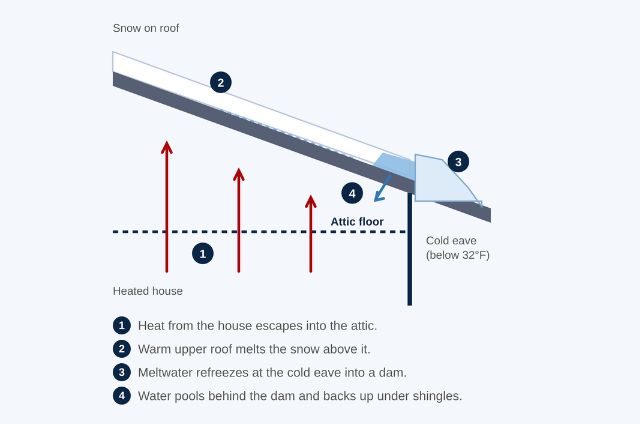
An ice dam is a ridge of ice at the edge of a roof that keeps melting snow from draining off. According to University of Minnesota Extension, it takes three things at once: snow on the roof, an upper roof surface above 32°F, and a lower roof surface below 32°F.
In most cases the warmth comes from the house, not the sun. Extension sources point to heat escaping into the attic, including through air leaks, as the main driver. For the full breakdown of causes, see what causes ice dams.
- STEP 1
Heat reaches the roof. Warm indoor air leaks into the attic and heats the roof deck from underneath.
- STEP 2
Snow melts on the warm part of the roof. The upper roof is above freezing, so the snow resting on it turns to water.
- STEP 3
Meltwater runs to the cold edge. The eave extends past the heated part of the house and stays below 32°F.
- STEP 4
The water refreezes into a dam. The ridge grows as more melting snow feeds it from above.
- STEP 5
Water backs up under the shingles. Meltwater that cannot drain pools behind the ice and works into the roof, then into the attic, walls or ceiling.
Why standing water gets in: Asphalt shingles are not waterproof. An engineering article from EFI Global in Claims Journal notes they shed water by slope and gravity, so water trapped behind ice can back up beneath them and enter the home.
What Removal Stops and What It Doesn't
Think of removal as shutting off the faucet, not cleaning up the spill. Here is the split:
The Source of the Backup
- Reopens drainage so meltwater is no longer trapped behind the dam
- Cuts off the water that was feeding an active leak
- Takes the weight of ice off gutters and trim
Everything the Water Already Did
- Wet insulation, drywall and wall framing
- Damaged shingles, flashing or underlayment
- The heat loss that built the dam
What removal handles: Ice Dam USA's service page describes its goal as restoring drainage and reducing the meltwater trapped behind the dam. The University of Minnesota notes that channels through a dam let trapped water drain, but calls them a temporary fix that stops working within days. The EFI Global authors note that ice and snow weight can pull gutters, fascia and soffit trim away from the roof edge.
What it doesn't: the University of Minnesota advises drying wet areas right away and waiting to repair interior finishes until they are dry. And if heat keeps escaping into the attic, the conditions that built the dam can return. North Dakota State University Extension notes that removing snow from the lower roof takes away the water source for dams near the gutter.
Removal is not repair. Clearing ice and fixing a roof or a ceiling are different jobs. Ice Dam USA's service page describes removal and drainage, not roof or interior repair, so plan for those steps separately.
Why Interior Damage Can Continue After the Dam Is Gone
Ice dam water has a long list of places to go. University of Missouri Extension lists dislodged shingles, sagging gutters, damaged insulation, and water stains on ceilings and interior walls. It adds that the water can decay framing, corrode fasteners, and lead to mold and mildew in attics and walls.
Hidden water. A UMass Amherst Building and Construction Technology article warns that moisture can get trapped in wall cavities, and that paint can peel long after the ice and the leak are gone. Its advice is not to patch only the spot where water showed up, since water can travel along paths that are hard to trace. Check the underside of the roof sheathing, the roof trim and the attic insulation for dampness. The article is archived from 2011, so treat it as an explanation of the mechanism, not as current code guidance.
Wet insulation. The same article says wet insulation can stay compressed after drying. Thinner insulation has a lower R-value, so more heat escapes, which sets up the next dam.
The drying clock. The EPA says to dry water-damaged areas and items within 24 to 48 hours to prevent mold growth. Its remediation guidance also notes that mold will not always grow after 48 hours, so treat the window as a target to move fast, not a cutoff after which nothing can be saved.
When Removing the Ice Won't Stop the Leak
Not every ceiling stain comes from an ice dam. The EFI Global article gives investigators a few tests that apply to homeowners too. Icicles are a clue, not proof: they show snow is melting and refreezing on the roof, which justifies a closer look.
Fits an Ice Dam
- Stain along an exterior wall near the eaves
- First appeared in winter or a shoulder season
- Ice or icicles along the same stretch of eave
Points to Something Else
- Stain in the middle of a room, or far above the eave line
- First appeared in warm weather, such as July, which points to causes like failed roofing or wind-driven rain
If your leak does not fit the ice dam pattern, removing ice will not solve it. Have a roofer inspect the roof. For more on reading a stain, see what a water stain on your ceiling means.
Is Ice Dam Removal Worth It if the Roof Already Leaks?
In most cases, yes, because an active leak means the dam is still holding water against the roof. Waiting leaves that source in place while more material gets wet. If water is coming in right now, our guide on what to do when your roof leaks covers the first steps.
Doing it yourself is the harder call. The University of Minnesota warns that anyone on a roof in winter risks injury and recommends contacting professionals. The EFI Global authors say that in their experience, a common cause of shingle damage is attempts to remove ice with tools that scratch, tear or puncture the shingles, whether the person holding them is a homeowner or a roofer.
That is why method matters. Ice Dam USA's approach, described on its ice dam removal page, is professional low-pressure steam: heat to open drainage paths, not hammers, chisels or high-pressure water. Large or widespread dams may need to be removed in stages. Heat cables are a mixed bag: EFI Global says meltwater can refreeze lower down in gutters or downspouts and keep the ice building.
Cost and coverage: Ice Dam USA's FAQ states that most insurers cover removal once water is leaking into the home and tells homeowners to verify coverage with their insurer before work begins. Policies differ, so confirm yours. For current rates, see the ice dam removal pricing page.
Callers with water coming inside are put on a high priority list, per Ice Dam USA's FAQ.
Where Ice and Water Shield Fits In
Ice and water shield is a waterproof membrane installed under the shingles at the eaves. EFI Global describes it as adhered directly to the roof sheathing, with watertight laps and seals around nail penetrations.
Key point: It does not prevent ice dams, but it reduces the interior moisture damage that can result.
That makes it a backup layer, not a cure. The UMass article calls membranes a reasonable stopgap for many existing homes but says they treat the symptom while the real problem is heat loss.
Building codes recognize the risk. The International Residential Code, section R905.1.2, calls for an ice barrier in areas with a history of ice forming along the eaves and causing a backup of water. The barrier can be two layers of underlayment cemented together or a self-adhering polymer-modified bitumen sheet. Whether it is required where you live depends on your local code, so ask your building department or roofer.
Practical takeaway: if your roof has a membrane at the eaves, interior damage from a dam may be smaller. If it does not, fast drying after removal matters even more.
After Removal: What to Do, in Order
The order matters because drying is time-sensitive and heat loss is the long game.
Find the Water You Can't See
Check the attic for damp insulation, sheathing and roof trim, even if no stain has appeared yet. The UMass article advises looking at the underside of the roof sheathing, the roof trim and the insulation.
Dry Wet Materials Quickly
Aim for the EPA's 24 to 48 hour window. Hold off on interior repairs and repainting until ceilings and walls are fully dry, as University of Minnesota Extension advises.
Have the Roof Checked
A roofer can look for shingle or flashing problems from age, wind or past removal attempts. EFI Global notes that shingle trouble usually traces to age, wind or tool damage, and rarely to ice dams alone.
Take Away What Feeds the Next Dam
Removing snow from the lower roof removes the water source. See our roof snow removal service and gutter ice removal.
Fix the Heat Loss
Montana State University Extension says the solution is almost always improved attic insulation combined with air sealing. University of Minnesota Extension says to make the ceiling airtight first, then consider adding insulation. Learn more about attic insulation and ice dam prevention.
Frequently Asked Questions
Can removing ice dams stop interior water damage?
It can stop new water from backing up under the shingles and entering the home. It does not dry insulation, drywall or wall cavities that are already wet. The EPA advises drying water-damaged materials within 24 to 48 hours to help prevent mold growth.
Can an ice dam cause interior water damage?
Yes. University extension sources describe ceiling and wall stains, wet and damaged insulation, dislodged shingles and sagging gutters. Over time, trapped moisture can also lead to decayed framing, corroded fasteners, and mold and mildew.
How do ice dams cause roof leaks?
Heat from the house warms the roof and melts snow. The water runs to the colder edge and refreezes into a ridge of ice. Later meltwater pools behind the ridge and can back up under the shingles, which shed water by slope and gravity and are not designed to hold it back.
Will removing an ice dam stop my ceiling from leaking?
If the dam is what is feeding the leak, removal can cut off that water. If the stain is mid-room, high on a wall, or showed up in warm weather, the cause may be something other than ice damming, and a roofer should inspect the roof.
Is ice dam removal worth it if my roof already leaks?
Usually, because an active leak means water is still being held against the roof. Removal deals with that source. You will still need to dry the interior, have the roof checked, and address the heat loss that formed the dam. See the full Ice Dam USA FAQ for more.
Sources
- University of Minnesota Extension, Dealing with and preventing ice dams (reviewed 2022).
- University of Missouri Extension, Ice dams on the roof can damage your home.
- North Dakota State University Extension, Reduce ice dam and icicle damage (January 2023).
- Montana State University Extension, Chris Dorsi, Preventing Ice Dams, LIVES landscapes, winter 2019.
- University of Massachusetts Amherst Building and Construction Technology, Preventing Ice Dams (archived article, 2011).
- Sarah Byer and John Gilewicz, EFI Global, Ice Dams Are Actually a Common Risk: What Claims and Insurance Pros Should Know, Claims Journal, October 22, 2025.
- U.S. Environmental Protection Agency, Mold and moisture guidance, and Mold Remediation in Schools and Commercial Buildings, Chapter 4.
- International Residential Code section R905.1.2 (ice barriers), as quoted in the Montana Building Codes Division Technical Advisory T1-16.
- Ice Dam USA, Ice Dam Removal and Frequently Asked Questions.
This article is general information, not a diagnosis of any specific roof or a statement about insurance coverage. Coverage, building code requirements and conditions vary by home and location.
Roof Leaking From an Ice Dam?
Tell us what you see and whether water is coming inside. We respond 24/7 with low-pressure steam removal, so the ice comes off without hammers or chisels.
Ice dam removal for homes and commercial buildings. Callers with active leaks are prioritized.