
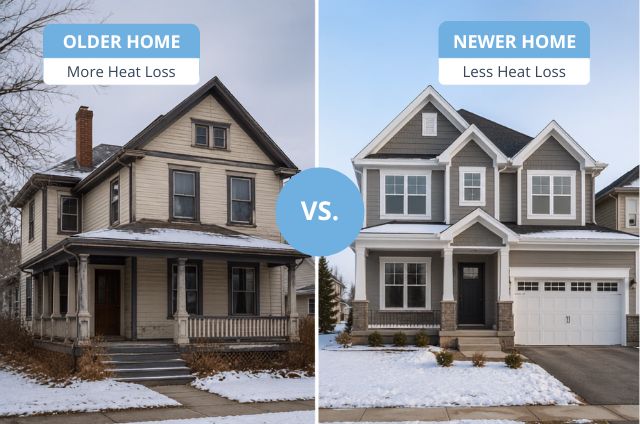
Why Older Homes Lose More Heat Than Newer Homes
You keep turning up the thermostat, but certain rooms stay cold. Your heating bills climb every winter, yet the house never feels truly warm. If you live in a home built before 1980, you're not imagining it — older homes lose dramatically more heat than homes built to modern standards, and the reasons go far deeper than just "less insulation."
This isn't just about comfort or utility bills. In northern climates, all that escaping heat creates a specific problem: ice dams. When heat leaks through your roof, it melts snow that refreezes at the eaves, backing water under shingles and into your home. Understanding why older homes lose heat is the first step to preventing both the energy waste and the roof damage that follows.
Here's what actually causes the problem, how much it costs you, and which fixes deliver the biggest impact without gutting your entire house.
Which Type of Homeowner Are You?
Just Bought an Older Home
You love the character and craftsmanship, but you're shocked by the heating bills. Some rooms are freezing while others overheat. You want to prioritize improvements without wasting money on fixes that won't matter.
What you need: a clear ranking of which upgrades deliver measurable results first.
Dealing With Ice Dams
You've had ice dams before, maybe even water damage. You know removing the ice is just a temporary fix. You want to understand the root cause so you can actually solve the problem instead of calling for emergency removal every winter.
What you need: the connection between heat loss and ice dam formation, explained clearly.
Long-Time Owner of Pre-1980 Home
You've lived in this house for years. The drafts are familiar, but heating costs keep climbing. You're wondering if improvements are even worth it at this point, or if older homes just cost more to heat no matter what you do.
What you need: realistic expectations about what's achievable and which fixes pay for themselves.
What Changed: How Building Codes Evolved
If your home was built before 1980, it was constructed before the energy crisis fundamentally changed how we think about building science. Pre-1970s homes were built with virtually no insulation standards and no requirements for air sealing. Heating fuel was cheap, and builders focused on structure, not energy efficiency.
Here's what that meant in practice:
Minimal to No Insulation
- Attics: 0–3 inches of insulation (R-0 to R-11)
- Walls: often completely uninsulated
- Basements and crawlspaces: never insulated
- Windows: single-pane with no weatherstripping
- No vapor barriers or air sealing concepts
Energy Code Requirements
- Attics: R-49 to R-60 in cold climates
- Walls: R-20+ with continuous insulation
- Basements: R-15 minimum on foundation walls
- Windows: double or triple-pane, low-E coatings
- Mandatory air sealing and blower door testing
The difference isn't just better materials. The entire approach changed. Modern homes are designed as integrated thermal envelopes where every penetration is sealed, insulation is continuous, and mechanical ventilation replaces leaky construction. Older homes were built to breathe naturally — which is another way of saying they leak air constantly.
Key point: A typical pre-1980 home has an air leakage rate 3–5 times higher than a modern home. This isn't a minor difference — it's the equivalent of leaving a window open 24/7 during winter.
The Five Biggest Heat Loss Points in Older Homes
Heat doesn't just disappear randomly. It follows predictable paths out of your house, and older homes have structural features that modern homes specifically engineered out. Here are the major culprits, ranked by typical impact:
1. The Attic (30–40% of Total Heat Loss)
Heat rises, and in older homes, the attic is where it escapes fastest. Most pre-1980 attics have inadequate insulation that's settled over decades, plus countless air leaks around:
- Recessed light fixtures (each one can leak as much air as a 2-inch hole)
- Plumbing vents and bathroom fans
- Chimney chases and attic hatches
- Top plates of wall framing
- Electrical penetrations
What makes this worse: Even if someone added insulation years ago, fiberglass batts don't stop air movement. Without proper air sealing underneath, warm air flows right through the insulation and heats the roof deck — the exact mechanism that causes ice dams.
2. Windows and Doors (15–25% of Heat Loss)
Single-pane windows conduct heat out through the glass itself, but the bigger problem is air leakage around frames. Over time, caulking fails, wood shrinks, and weatherstripping deteriorates. A poorly sealed door can leak as much air as a heating duct.
Original windows in homes built before 1950 often have beautiful wood frames but no thermal breaks, no insulated glass, and no effective seals. Storm windows help, but they're a band-aid on a fundamental thermal weakness.
3. Basement and Foundation (15–20% of Heat Loss)
Older homes have uninsulated foundation walls and rim joists (the band of wood where the foundation meets the house framing). Cold basement air leaks up through gaps in the floor, and heat conducts directly through concrete walls into the ground.
The rim joist area is particularly problematic because it's typically just open cavities between floor joists with no insulation or air sealing. This creates a continuous thermal bridge around your home's entire perimeter.
4. Wall Cavities (10–15% of Heat Loss)
Many older homes have completely hollow wall cavities with no insulation. Even homes that were retrofitted often have gaps where insulation was blown unevenly or settled over time. Unlike attics and basements, walls are expensive to improve because they require either drilling holes for blown insulation or removing interior finishes.
5. Ductwork and Mechanical Systems (10–20% of Heat Loss)
If your home has forced-air heating, leaky ducts can lose 20–30% of heated air before it reaches living spaces. Older duct systems were often installed without proper sealing, and gaps develop at joints over time. Ducts in unconditioned attics or crawlspaces leak heated air directly outside your thermal envelope.
↑ What Pushes Heat Loss Higher
- Settled or missing attic insulation
- No air sealing around penetrations
- Original single-pane windows
- Uninsulated foundation and rim joists
- Leaky ductwork in unconditioned spaces
- Recessed lights without sealed housings
- Balloon framing (common pre-1950)
↓ What Keeps Heat Loss Lower
- R-40+ attic insulation properly installed
- Comprehensive air sealing (especially attic floor)
- Double or triple-pane windows
- Insulated and sealed rim joists
- Sealed ductwork with mastic (not just tape)
- Weatherstripped doors and windows
- Platform framing with fire stops
What Heat Loss Actually Costs You
The financial impact of excessive heat loss shows up in three places: your monthly utility bills, emergency repairs from ice dams, and accelerated wear on your heating system. Here's what that looks like in real numbers for northern climates:
Annual Heating Cost Comparison (2,000 sq ft home, Minnesota climate)
R-11 attic, single-pane windows, no air sealing, uninsulated basement
R-49 attic with air sealing, storm windows, sealed rim joists
R-60 attic, triple-pane windows, comprehensive air sealing, R-20 walls
Over a 10-year period, an unimproved older home can cost $10,000–$15,000 more to heat than a modern home of the same size. That's before accounting for ice dam removal, water damage repairs, or premature furnace replacement from constant cycling.
Reality check: The good news is you don't need to match modern home performance to see dramatic savings. Most older homes can cut heating costs by 30–40% with targeted improvements that cost $3,000–$8,000 total. The payback period is typically 4–7 years through energy savings alone, faster if you factor in avoided ice dam damage.
Why This Causes Ice Dams
Here's the connection many homeowners miss: ice dams aren't caused by snow or cold weather. They're caused by heat escaping through your roof. Every gap in your attic insulation, every unsealed penetration, every square foot of inadequate insulation sends warm air up into your attic space.
That escaping heat warms the roof deck from underneath. When snow lands on the roof, the warm sections melt it. The water runs down toward the eaves, but the eaves are cold (they extend past your home's heated envelope). The meltwater refreezes at the cold eaves, forming a dam. More meltwater backs up behind the dam and eventually finds its way under shingles and into your home.
The Ice Dam Formation Process
Heat escapes through attic due to poor insulation and air leaks
Roof deck warms to above freezing, melting bottom layer of snow
Meltwater flows down roof toward eaves, which remain cold
Water refreezes at eaves, building an ice dam that blocks drainage
Water backs up under shingles, penetrating roof and entering home
This is why newer, well-insulated homes rarely get ice dams even in heavy snow. Their roofs stay cold because heat isn't escaping into the attic. The entire snow layer remains frozen, and there's no meltwater to refreeze at the eaves.
Older homes, with their minimal insulation and countless air leaks, can't keep heat inside. The result is a self-perpetuating cycle: heat loss creates ice dams, ice dams cause water damage, and homeowners focus on removing ice rather than fixing the insulation problem that's generating it.
Non-negotiable truth: You cannot prevent ice dams with roof treatments, heating cables, or better gutters. Those are all reactive measures. The only permanent solution is stopping heat from escaping through your roof in the first place. Learn more about what causes ice dams.
Where to Start: Fixes Ranked by Impact
If you're trying to improve an older home's thermal performance, the order matters. Some improvements deliver 10 times the return of others. Here's the priority ranking based on cost-effectiveness and ice dam prevention impact:
Attic Air Sealing
Cost: $800–$2,000 (DIY possible for handy homeowners)
Impact: Can reduce attic heat loss by 30–50%
Seal every penetration in the attic floor: top plates, plumbing vents, chimney chases, recessed lights, attic hatch. Use spray foam or caulk depending on gap size. This is the single highest-ROI improvement because it stops convective heat loss — the warm air literally rising into your attic.
Attic Insulation Upgrade
Cost: $1,500–$3,500 (blown cellulose or fiberglass)
Impact: Can reduce total home heat loss by 20–30%
Bring attic to R-49 minimum (R-60 is better in northern climates). ONLY effective if you air seal first — otherwise warm air flows through the insulation. Blown insulation is usually more cost-effective than batts for retrofit work.
Rim Joist Insulation/Sealing
Cost: $600–$1,500 (DIY friendly)
Impact: Reduces basement/first floor heat loss by 10–15%
Spray foam or rigid foam board the rim joist cavities around your home's perimeter. This addresses a major thermal bridge and air leakage point that's often completely overlooked. Accessible from basement or crawlspace.
Window Upgrades or Storms
Cost: $150–$350 per window (storms) or $500–$1,200 (replacement)
Impact: Reduces window heat loss by 40–60%
Storm windows are the cost-effective option if your existing windows are structurally sound. Full replacement makes sense if frames are rotted or if you're doing exterior work anyway. Focus on north-facing windows first.
Duct Sealing
Cost: $500–$1,200 (professional) or $100–$300 (DIY)
Impact: Recovers 15–25% of lost heating capacity
Seal all accessible duct joints with mastic (not duct tape, which fails). Focus on ducts in attics, crawlspaces, and basements. Consider insulating ducts in unconditioned spaces to R-8 minimum.
Wall Insulation (If Uninsulated)
Cost: $1.50–$3.50 per square foot
Impact: Reduces overall heat loss by 10–20%
Blown-in cellulose or foam through drilled holes. Lower priority than attic because walls have less surface area and the work is more disruptive. Worth it if walls are truly empty, less so if they have partial insulation.
Recommended starting approach: Priorities #1 and #2 together (attic air sealing + insulation) typically cost $2,500–$5,500 and deliver 40–60% of the total possible improvement. Do these first. Then assess whether your heating bills and ice dam risk justify additional work. For many homeowners, getting the attic right solves 80% of the problem.
Frequently Asked Questions
Why is my old house so drafty? +
Older homes are drafty due to settling foundations that create gaps, deteriorated window and door seals, uninsulated wall cavities, leaky ductwork, and outdated construction methods that didn't prioritize air sealing. Over decades, caulking fails, wood shrinks, and countless small gaps develop throughout the building envelope.
The draftiness you feel isn't just one big leak — it's hundreds of small air infiltration points around electrical outlets, baseboards, window frames, door thresholds, and attic penetrations. Modern homes are built with comprehensive air barriers and testing to limit air changes per hour; older homes had no such standards.
How much more heat do older homes lose compared to newer homes? +
Older homes can lose 25–50% more heat than newer homes built to modern energy codes. A typical pre-1980 home might have an air leakage rate 3–5 times higher than a home built after 2000, resulting in significantly higher heating bills and comfort problems.
In practical terms, this means a 2,000-square-foot older home in Minnesota might cost $2,800–$4,200 annually to heat, while a similar-sized modern home costs $1,400–$1,900. The difference compounds over decades of ownership.
What's the biggest source of heat loss in an older home? +
The attic is typically the largest source of heat loss in older homes, often accounting for 30–40% of total heat loss. This happens because heat rises naturally, and most older homes have inadequate or settled insulation, plus air leaks around penetrations like chimneys, plumbing vents, and recessed lights.
Even if someone added insulation years ago, attic heat loss remains severe without proper air sealing underneath the insulation. Warm air flows through unsealed gaps, heats the attic space and roof deck, and escapes through roof vents — exactly the mechanism that causes ice dams.
Does fixing heat loss in an older home prevent ice dams? +
Yes. Ice dams form when heat escapes through your roof, melting snow that then refreezes at the cold eaves. By improving attic insulation and air sealing, you keep heat inside your living space instead of warming the roof deck, which is the root cause of most ice dam problems.
This is why properly insulated modern homes rarely experience ice dams even in heavy snow years. Their roofs stay cold because heat isn't escaping into the attic space. Fixing heat loss is the only permanent ice dam prevention strategy — everything else (heating cables, roof rakes, better gutters) just manages symptoms. See our guide on professional ice dam removal for emergency situations.
Can I improve an older home's insulation without major renovations? +
Yes. The most effective improvements don't require tearing open walls. Adding attic insulation, air sealing the attic floor, weatherstripping doors and windows, insulating rim joists in the basement, and sealing ductwork can dramatically reduce heat loss without major construction.
These targeted improvements typically cost $3,000–$8,000 total and can reduce heating costs by 30–40%. Wall insulation is the only common upgrade that requires invasive work (drilling holes or removing siding), and it's often not necessary if you've addressed the attic, basement, and air leakage properly. Many homeowners see ice dam problems disappear after attic work alone.
Is adding insulation enough, or do I need air sealing too? +
Air sealing must come first. Adding insulation without air sealing is like putting on a thick sweater over a mesh shirt — it helps, but warm air still flows right through. Fiberglass insulation slows conductive heat loss but does nothing to stop convective heat loss (actual air movement).
In older homes, air leakage typically accounts for 25–40% of heat loss. If you only add insulation, you're only addressing conductive losses. Professional energy auditors consistently find that air sealing the attic floor before adding insulation delivers 2–3 times better results than insulation alone. The combination is what creates a true thermal barrier.
Should I replace my old windows or add storm windows? +
If your existing windows are structurally sound with intact wood and functioning hardware, high-quality storm windows deliver 60–70% of the thermal performance of full replacement at 20–30% of the cost. They're the smarter financial choice for most older homes.
Full replacement makes sense if frames are rotted, sashes won't stay open, or you're already doing exterior work that requires removing siding. But from a pure heat-loss perspective, interior or exterior storm windows over well-maintained originals perform nearly as well as new double-pane units. Focus window money on north-facing windows first — they lose the most heat and gain no solar benefit.
How do I know if my walls have insulation? +
The most reliable method is removing an outlet cover on an exterior wall and shining a flashlight into the gap around the electrical box. If you see empty cavity space, your walls are uninsulated. If you see fluffy material (fiberglass or cellulose), you have some insulation.
You can also hire an energy auditor with an infrared camera to scan your walls — uninsulated cavities show up as dramatically different temperatures. Before 1950, most homes had no wall insulation. Between 1950–1980, it was hit or miss depending on local codes and builder practices. If your home was built before 1970 and you've never had insulation added, assume walls are empty until proven otherwise.
Dealing With Ice Dams This Winter?
If you're already facing an ice dam emergency, professional steam removal protects your roof while you plan the insulation work that prevents future problems. We serve homeowners throughout the northern United States with safe, effective ice dam removal.
Contact Us Today Find Your LocationNo pressure. No pitch. Just honest answers and professional service when you need it.
