
Why Does Ice Form in Gutters First?
The roof is mostly clear, but the gutters are packed with ice and icicles are hanging off the edge. Why there?
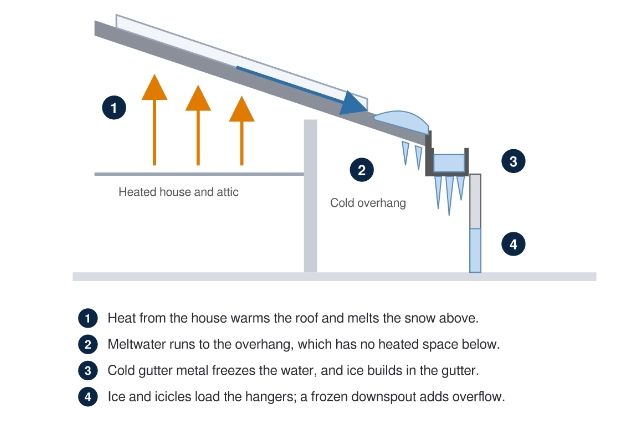
Because the gutter is the coldest, last stop for water coming off the roof. It hangs past the wall, has no heated space behind it, and is made of thin metal that matches the outdoor air. Meltwater that reaches it freezes, and every freeze and thaw cycle adds another layer.
This guide explains why gutters freeze first, what clogged downspouts and gutter weight do, what icicles are telling you, and what is safe to try before you call for ice dam removal from gutters.
What Kind of Gutter Ice Do You Have?
Ice Only in the Gutters
The roof above is bare or nearly bare, but the gutter is a solid channel of ice.
Likely story: a clog, a sagging section or a frozen downspout is holding water in place.
A Ridge of Ice Over the Gutter
Ice is built up along the roof edge and spills over the gutter, often with large icicles.
Likely story: an ice dam on the roof edge, usually driven by heat loss into the attic.
Icicles and Little Else
Icicles hang from the gutter or eave, but the gutter itself still drains.
Likely story: snow is melting and refreezing on a sunny or leaky section of roof. Worth watching.
Why the Gutter Freezes Before the Rest of the Roof
Three things make the gutter the first place ice shows up.
1. It sits at the eave edge, past the heated house
North Dakota State University Extension says ice dams tend to form on the lower part of the roof, where it meets the wall and overhang and temperatures are colder. The overhang has no attic or living space beneath it, so it stays near outdoor temperature. The gutter is attached to the very end of that overhang.
2. Metal gives up its heat fast
Ask the Builder says metal conducts cold very well, so ice can form in a gutter as soon as the temperature hits 32°F. Once ice starts, water running over it is chilled too, and the layer grows.
3. It extends the edge
Canadian Building Digest 89 notes that gutters may increase ice formation on roof edges. They do not cause ice dams, since ice dams form on roofs with no gutters at all, but they add cold surface where ice can grow.
The short version: heat from the house melts the snow higher up, and the gutter is where that water arrives at a below-freezing surface. For the full cause, see what causes ice dams.
How Freeze and Thaw Builds the Ice
University of Minnesota Extension says an ice dam needs snow, an upper roof above 32°F and a lower roof below 32°F. Gutter ice follows the same pattern, repeated over days.
- STEP 1
Snow melts. Heat leaking into the attic, or sun on a south-facing slope, warms the roof. NDSU Extension also notes that sun can warm the gutter and soffit edge enough to melt snow and make icicles.
- STEP 2
Water runs to the edge. It flows down the roof toward the eave.
- STEP 3
It freezes in the gutter. The cold metal and overhang chill the water on contact.
- STEP 4
The next thaw adds more. Each warm spell sends fresh water onto the ice already there, and it freezes again at night.
- STEP 5
The gutter fills and spills. Water that cannot enter the channel runs over the lip and freezes as icicles.
Do Clogged Gutters Cause Ice Dams?
Not on their own. Angi notes that ice dams form on houses with or without gutters, because every roof has an edge. A clog does make gutter ice more likely: debris holds water in place so it can freeze, and meltwater has nowhere to go. But the same source adds that meltwater can refreeze in a gutter even when nothing is blocking it.
Water Can't Leave the Gutter
- Ice is worst where leaves or debris collected
- The roof above is mostly clear
- Cleaning in fall helps, and the guide linked below covers how
Too Much Meltwater Arrives
- Ice builds along the roof edge as well as in the gutter
- Large icicles or a ridge of ice over the gutter
- Clean gutters still freeze, and the fix is in the attic
Cleaning before winter is still worth doing. Timing and steps are covered in our guide on cleaning gutters before winter.
Frozen Downspouts and Gutter Weight
Clogged downspouts. Ask the Builder explains that when gutter meltwater meets a cold downspout, it can freeze and block the pipe. With the exit sealed, water from the roof goes over the top of the gutter instead, which often produces large icicles.
Weight. Ice is heavy, and the gutter is held on by fasteners at the very edge of the house. The same source says the weight of ice in the gutter and the icicles can rip gutters from the house when it overwhelms the fasteners. University of Missouri Extension lists sagging gutters among the damage ice dams cause, and Angi notes that the weight of ice dams can break gutters off the roof, and a falling gutter can hurt someone.
Warning signs: a gutter that bows, pulls away from the fascia, or sits lower than it did in fall is carrying more than it was built for. Keep people and pets away from beneath it.
Are Icicles on My Roof a Problem?
It depends on what they are attached to. NDSU Extension says ice dams and icicles are most common when snow is on the roof, heat is escaping through it, and outdoor temperatures are just below freezing.
Usually Not Urgent
- A few small icicles on a sunny day
- Gutters still draining
- No ice ridge along the roof edge and no stains inside
Worth Acting On
- Large or persistent icicles along one stretch of eave
- Gutters packed with ice or pulling away
- A ceiling or wall stain near the same area
An EFI Global article in Claims Journal calls icicles a clue, not proof of an ice dam: they show snow is melting and refreezing, which justifies a closer look. Angi warns that heavier icicles can cause serious injuries if they fall, especially on sunny days when they loosen.
Ice Dam Removal From Gutters: What Is Safe and What Isn't
Packed gutters are heavy and slippery, and ladders, ice and falling icicles are a bad mix. Here is the order that keeps you and the house safest.
Stay Out From Under the Ice
Keep people, pets and vehicles away from icicles and sagging gutters until the ice is dealt with.
Take Snow Off the Lower Roof From the Ground
NDSU Extension says clearing snow from the lower part of the roof reduces icicles and dams near the gutter, because the water source is gone. Use a long-handled roof rake and stay on the ground.
Don't Chop, and Skip the Salt
An Angie's List piece in The Gazette says professional gutter cleaners see heavy damage from chopping at ice with a hammer or axe. It also advises against salt or chemical melters, which can corrode roofing and harm plants.
Call a Professional if Gutters Are Packed or Water Is Coming In
Ice Dam USA's gutter ice removal uses low-pressure steam rather than hammers or chisels. The same Angie's List piece says to call a professional right away if water has started leaking into the house.
Fix the Cause Before Next Winter
Clearing the gutter does not change why snow melted. Extension sources point to attic air leaks, insulation and ventilation. Start with our Learning Center and see ice dam removal if a dam is already on the roof.
Frequently Asked Questions
How do I remove ice from gutters?
Start from the ground. Rake snow off the lower roof if you can reach it safely, and do not chop at the ice or use salt. If the gutters are packed solid or water is coming inside, a professional using low-pressure steam can clear them without hammers or chisels. Never climb onto an icy roof or ladder to fight ice yourself.
How do I remove an ice dam from a gutter?
Strictly speaking, an ice dam forms on the roof edge and can spread over the gutter. Removing it means melting or cutting channels so trapped water can drain, which is difficult and risky to do yourself. University of Missouri Extension describes warm tap water as a way to make channels, but notes they stop working within days. For packed gutters or active leaks, call a professional.
What is the difference between removing ice dams from gutters and removing ice from gutters?
Ice in the gutter is a drainage and weight problem. An ice dam on the roof edge is a water-backup problem that can lead to leaks. They often show up together, since the same meltwater feeds both.
Why are my gutters frozen?
Gutters hang past the wall at the coldest edge of the roof and are made of thin metal that sits at outdoor temperature. Meltwater from the warmer roof, or from a sunny afternoon, reaches them and freezes. A clog or a frozen downspout holds the water in place so it freezes faster.
Do clogged gutters cause ice dams?
Not by themselves. Ice dams form on roofs with or without gutters, and the main driver is heat escaping into the attic. Clogged gutters can make gutter ice worse and give meltwater nowhere to go, but fixing a clog will not stop a dam that heat loss is feeding.
Are icicles on my roof a problem?
Small icicles can be harmless. Large or persistent icicles, ice packed into gutters, or icicles along with a stain inside are worth acting on. Falling icicles can injure people, and heavy ice can pull gutters away from the house.
Sources
- North Dakota State University Extension, Reduce ice dam and icicle damage (January 2023).
- University of Minnesota Extension, Dealing with and preventing ice dams.
- University of Missouri Extension, Ice dams on the roof can damage your home.
- Canadian Building Digest 89 (National Research Council of Canada), hosted by MIT.
- Ask the Builder, Gutter Ice (Q&A column).
- Angi, Do Gutters Cause Ice Dams to Form?, Why Do Icicles Form on Houses?, and How to Remove and Prevent Ice Dams.
- Sarah Byer and John Gilewicz, EFI Global, Ice Dams Are Actually a Common Risk, Claims Journal, October 2025.
- Angie's List, What can I do about frozen gutters?, The Gazette, December 23, 2018.
- Ice Dam USA, Gutter Ice Removal.
This article is general information, not a diagnosis of any specific roof. Conditions vary by home and location.
Gutters Packed With Ice?
Tell us what you see and whether water is coming inside. We respond 24/7 with low-pressure steam, so the ice comes off without hammers or chisels.
Gutter and ice dam removal for homes and commercial buildings.